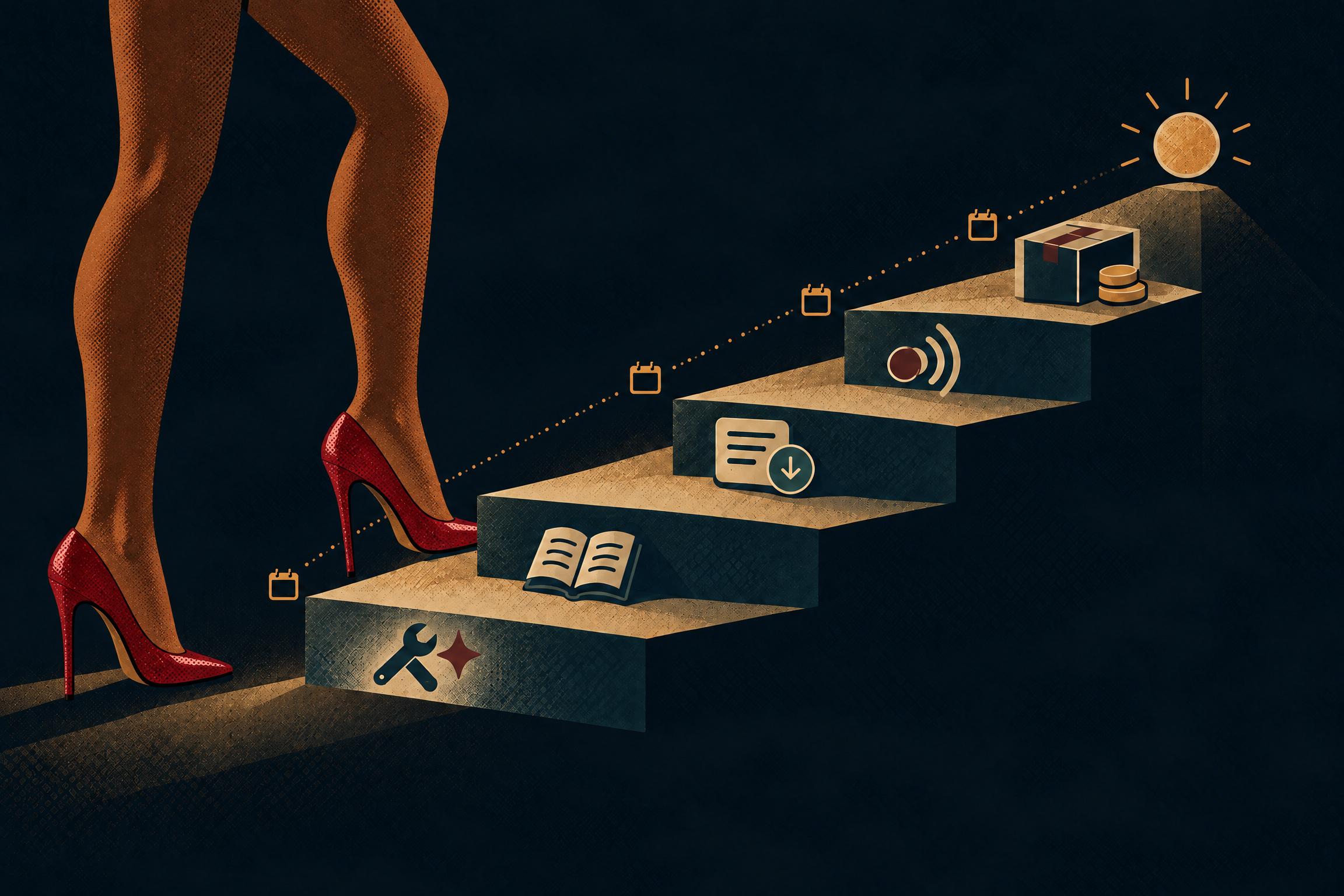
Stop Asking AI What Business You Should Build. Use This Prompt Instead.
Nyaradzo
November 29, 2026
I'm done asking ChatGPT and Claude what business I should build.
Let's have some real talk.
I make content for disgustingly ambitious professionals using AI to build more skills, wealth, and freedom. I also talk to AI more than I talk to my own inner voice.
And while I've been figuring out what to prioritize in 2027, I found the thing that's been keeping me stuck.
It's AI.
Or more accurately, it's the way I've been using it.
The prompt I had been running for months
Here is what I was doing, almost every week.
I'd open Claude, turn on incognito mode so nothing carried over, and ask for a verdict on my entire life:
Research me and the market, and tell me which products or
businesses I should get into to reach an 8 to 9 figure exit
within the next 5 years, based on my background and my
unfair advantages.
That's the optimistic delusion at work, and I stand by the delusion.
The problem was the answers.
I'd get back things like B2B AI enablement. EdTech. Workforce upskilling for enterprise. All of it defensible. All of it a real market. None of it something I actually want to wake up and do for the next five years.
So I'd read the output, feel the air leave the room, and spend the rest of the day defeated. Not because the plan was bad, but because the plan wasn't mine.
Then I would do it again the following week and hope for a different answer.
Why that prompt keeps you stuck
After the session I had today, I realized I was using AI completely backwards in this one specific area. Three reasons it never worked:
- I handed over the decision that was mine to make. Asking a model what I should build turns my taste, my obsessions, and my willingness to suffer for something into inputs it cannot see or weigh.
- It optimizes for the safest market, not for the thing I will still be excited about in year four. A model asked to maximize an outcome will route you to the path with the most proof already on the internet.
- It kept me in research instead of in motion. Every new verdict reset me to zero. I was collecting opinions about my life instead of building it.
AI is supposed to help us feel more alive and excited to pursue what we actually want. Not handcuffed to a path that was never ours.
Our AI works for us. Not the other way around.
The flip
So I changed one thing about the order of operations.
Now my prompt starts with exactly what I want to build and what excites me about it. The goal is already decided before the model says a word. Then I ask AI to research the simplest path to my delusional outcome.
The model is no longer the judge. It's the strategist. That's the whole shift.
The prompt I promised you
This is the one I use now for future planning. Copy it, fill in the brackets, and run it in a fresh chat.
You are my strategic advisor and researcher. You are not here
to pick my business for me. The direction is already decided.

WHAT I AM BUILDING
[Describe the business, product, or body of work in 3 to 5
sentences. Say it in plain language, as if you were telling
a friend.]

WHY IT EXCITES ME
[The real reason. What you would still be doing if nobody
paid you for it.]

THE OUTCOME I WANT, WITH NO HEDGING
[Your delusional goal and the deadline. For example: an 8
figure exit in 5 years, or $50k a month in 18 months, or
100,000 people using it by 2030.]

WHAT I ALREADY HAVE
- Skills: [list them]
- Audience or distribution: [numbers, platforms, email list]
- Proof or credibility: [results, credentials, past work]
- Time and capital I can commit: [hours per week, dollars]
- Unfair advantages: [the things that are hard to copy]

WHAT I REFUSE TO DO
[The paths you do not want, even if they would work. Be
specific, because this is the part that usually gets
ignored.]

NOW DO FOUR THINGS

1. Research the market for the exact thing I said I am
building. Who is winning at it right now, what do they
charge, where is demand growing, and what is getting
commoditized? Give me sources and dates.

2. Work backwards from my outcome to today. Give me the
shortest credible path as yearly milestones, then the next
90 days, then this week. Show the math: price points,
conversion rates, and how many customers or units each
milestone requires.

3. Name the three assumptions my plan depends on most, and
give me the cheapest test for each one that I can run in
the next 14 days.

4. Tell me where my plan is actually weak, and how to
strengthen my version of it.

RULES
- Do not replace my idea with a different business, market,
or model. If you think my version is weak, keep my version
and make it stronger.
- Be specific with numbers. No ranges wider than 2x without
explaining the spread.
- Flag anything you are guessing or extrapolating.
- Do not give me a list of options. Give me one path.
- End with the single thing I should do first, today.
How to fill in the brackets so this actually works
A few notes from running it on myself.
- Write the exciting part before you write the goal. If you lead with the money, you will unconsciously describe a business you think can hit the number instead of the one you want.
- Make the refusal list real. Mine says no enterprise sales cycles and no building a business that only works if I disappear from the internet. That one constraint changed the entire plan I got back.
- Give it your actual numbers. Audience size, email list, hours per week, how much cash you can put in. Vague inputs produce a plan written for a stranger.
- Keep the deadline aggressive. The point of the exercise is to compress the path, not to get permission to take ten years.
The follow-ups that do the real work
The first answer is a draft. These are the three I send next, in this order:
Cut this plan in half. What is the version that gets to the
same 90 day milestone with half the work and half the spend?You are a skeptical investor who thinks this will fail.
Give me the strongest case against the plan, then tell me
which of your objections I should actually act on.Turn the next 14 days into a calendar. One task per day,
each one under 2 hours, ordered so that the riskiest
assumption gets tested first.That last one is the difference between a nice document and a week that looks different from the last one.
What changed for me
The plan I got back the first time I ran this was less impressive on paper than the B2B AI enablement verdict. Smaller market on day one. Slower first year.
But I opened my laptop the next morning and I knew exactly what to do, which had not been true in months.
Your delusional goal does not need a second opinion. It needs a research team.
So follow along if you'd like to see what it actually looks like to turn your most delusional goals into reality with AI. I share the prompts, the builds, and the parts that break inside my community.
Join Disgustingly Paid on Skool